Getting down from the Darjeeling Mail at New Jalpaiguri station, after a 569kM overnight journey from Calcutta, the head still hurts from the noise, heat and dust of the mega city. The journey from the platform to the street is a long walk on the overpass and includes a 2-storey staircase climb up & down. If your group has fewer strong hands than pieces of heavy luggage, immediately start haggling with the red shirted coolies (= porters). After coming out, it is best to take a bus (~Rs15 / head), a taxi or auto-rickshaw (~Rs80[i] for 2 with luggage) and escape hastily to Siliguri. Get down at SNT (Sikkim National Transport) bus stand. If you are going to Gangtok[ii], Rinchenpong, etc., better take the earliest possible next SNT bus. Otherwise, there are several Jeep Commanders, Mahindra Maxx, Tata Sumo, which ply to Gangtok, Pelling, Ravongla[iii] etc. If you are a repeat visitor, who knows the ropes and your destination is a little off the way, take a share taxi to Jorethang and then another to your destination. If there are several members in a group, it is worth hiring a whole car and fill up with fewer than the prescribed capacity, so that everybody has a few centimetres more space to stretch. Moving quickly is important, so that you reach your destination as early as possible You trundle out of Siliguri. Your have the first sight of Mahananda Wildlife Reserve. By and by you realise that the car in on a gentle upward slope. There is less pollution in the cooler air. The spirit rises on seeing the name of a roadside restaurant – Hotel Tista Rangit, names of 2 important rivers, both popular with white water rafters and kayakers. The curvy Sevok bridge passes by to the right. It looks like a smaller version of the parabolic Bremero bridge in the Autostrada, as one enters Italy from Austria and is nearly as old. The vehicle travels over bridges at Geil Khola, Tista and Lepcha Jhora (Jhora = small waterfall) one after the other and crosses from West Bengal (WB) into Melli Bazar, Sikkim. No, wait! Sikkim Police stops the car. Workmen in white coveralls approach with nozzles to spray the tyres and the inside of the car with disinfectants. All passengers have to walk a few paces, while a scented disinfectant washes the bottom of the shoes. You see, nobody has any faith on the slothful callousness of the Govt of WB, which keeps telling lies about culling of chicken, while bird flu rages[iv] in the state.
Those who suffer from motion sickness, even while driving in the gentle Swiss Alps, should now take an Avomine anti-vomit pill. For those who have successfully travelled without discomfort in the road climbing up to Darjeeling may sit back and relax. The roads of Sikkim are much better than those of WB. The hills rise, the valleys drop. You have glimpses of the gushing water far down there with a kayak or two bobbing down the river. At places, it is almost like standing at the edge of a green Grand Canyon, USA and looking down at a high speed Colorado river. If you had booked the vehicle exclusively for your own group, you can tell the driver to shut off that infernal noise of Hindi songs blaring out of the boom box. You breathe deeply in the clean jungle air.
The driver will make a halt for refreshment at some market town. Depending on your destination, it could be Jorethang, Singtam etc. If you halt at Singtam, you can look up to see the Pippali Gir (= butterfly fall), where even a butterfly would fall down the 100M steep cliff. There is a very narrow bend on the road above, which turns around another sharp cliff jutting out like a Frenchman’s nose. A continuous trickle of water washes the asphalt away to keeps the stones permanently exposed and slippery. They say a car takes about 40 min to drive from Pippali Gir to Singtam. If the car wheels slip, it reaches in four seconds. The flowering trees and plants like hibiscus and bougainvillea really show off what they can do in the mountain soil. Their reds are of brilliance unseen in the plains. Mandars[v] bear ruby rings on the tip of every finger-like bare branch. The green terraced rice field on the opposite hillside looks like a staircase to heaven. There are some flowers like cherry blossom Cherry tree
Clusters of very straight and smooth, high quality bamboo. The green terraced rice field on the opposite hillside looks like a staircase to heaven. As the car climbs higher, feather like ferns sway in the breeze with long fingers, whispering – “Come hither! Come hither!!”

The soul is at peace. Nope! I have spoken too soon. If the Alps is docile as a pet cat, the Himalay is a ferocious Bengal tiger. The car halts. The unpredictable mountain has chucked some rocks and stones
You retrace a few steps to take pictures of one of the innumerable waterfallsyou have passed by. By the time you are back and the driver has collected the co-passengers, the bulldozers have curved out a bumpy path for progress.
In Sikkim, the joy is more in travelling, than in reaching. Look carefully : every nook & cranny, every crack of stone, every long exposed root of tree, every sloped ray of sunshine has something to boast of. You keep turning your head back & forth, lest you miss something. After some time, you are lost in this fairy tale land.
The car reaches Gangtok and weaves towards the taxi stand through narrow zigzagging streets. You try in vain to make mental note of dozens of attractive spots, where you want to come back on foot. It is difficult to write down anything in the swaying car. Using the voice memo of the cellphone is better. It is not necessary to book hotel through travel agencies. Their commission will come out of your money. If like us, you have avoided the crowd of the peak tourist season, you can simply phone up hotels and haggle a good off-season discount. If there are several in your group, you can leave the luggage with one and the rest fan out to scout for price worthy hotels. Keeping communication with each other by cellphone is easy. Sikkim has an excellent cellular network except at border areas and almost very grown man has a phone. A few hotel :
1. Hotel Mayur, Panchwati Holiday Resorts Ltd., very centrally located, good quality. About Rs1,100 + 10% tax / double bed room. Phone Mr Rupesh Kumar, 94342 57278 / 97334 46705, rupesh_panchwati@rediffmail.com, www.panchwati.com. Be sure to insist on rooms facing the hills and NOT the road.
2. Hotel The Yalung Retreat, Mr Tushar Ghosh, General Manager, phone (03592) 201066, 98320 59302, very centrally located, a 2 storey climb up, just behind the BSNL Telephone Exchange, a few paces to city centre. All rooms, except top floor look out to the walls of the next buildings about 2M (~ 6ft) away. The 3rd floor rooms facing the Telephone Exchange give clear view to Kanchenjungha. If you are carrying a BSNL cellphone, the signal strength is zero, though the tower in about 15M away from the window. Seasonal rates Rs1,500 to 2,700 + 10% tax depending on room & tariff plan per double bed. We paid Rs550 + taxes for the top floor double room at off-season rates. The room service food is presentable & priceworthy.
3. Hotel Hungry Jack, 50M from Private Bus Stand, a staircase climb to M G Marg (the central pedestrian’s plaza) About Rs600-1,100 + 10% tax / double bed room. phone 94743 55699 / 97332 14039, hotelhungryjack@gmail.com, navinsukhani@gmail.com, www.hungryjack.com, www.sikkiminfo.net/hungryjack. Rooms facing the hills are better, those facing the road cheaper & noisy. If your memory is not razor sharp, in 5 min. you will think your hotel’s name is Hungry Horse – many do. Better ask for & carry the hotel’s card, lest you get lost. The restaurant at the ground floor offers good food, if you are stuck in rain or if you want European dishes only. Otherwise, take breakfast but eat out. Bang opposite the narrow road are several restaurants offering everything from South Indian to Bengali food.
4. New Orchid Hotel, Development Area, Opp Puspa garage, phone (03592) 204 998. Manager Pasang Sherpa alias Pasang Bhai 94341 17673 is a jovial man, who takes great enthusiasm in planning & arranging your site seeing trips, preferably before nightfall, thereafter it is better to let him enjoy his own time. The hotel is a little distant[vi] from the city centre in a quiet surrounding, up a short flight of stairs from street level. We stayed in the 3rd floor roadside room. At Rs600 + 10% tax / double bed, it was a large room with a very large bathroom and a view to Kanchenjungha. There is a large, well furnished empty dining room downstairs. The sound of a jhora, kept soothing company at night. Take breakfast, but eat out.
Almost all Sikkim hotels and many modest lodges accept booking from different cities. Payment of an advance amount through your local branch of their designated banks seals the deal.
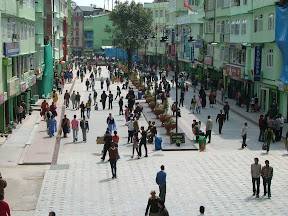
Take a quick bath, shove a light woollen, camera, batteries etc. into a handbag and venture out. The place to go first is the M G Marg, The Mall. After it was renovated, turned into a pleasant pedestrians’ plaza and inaugurated by the famous economist Montek Singh Ahluwala on 15.3.08, it is the place to linger around. First stop, preferably for lunch : Taste of Tibet phone 98620 74326, a 2nd floor[vii] restaurant at the other end of the plaza from the Tourist Office. If you are lucky, you get window seats. Two of you can order 1 plate (8 pieces, Rs30) of steamed pork momo (like dumplings) & a cup of Thhukpa (comes with momo) and 1 bowl (Rs45) of Gyathuk (like mixed chow mien in soup) split for 2. If you are still hungry, there are other delicacies like chow mien of different mixtures. By this time, watching other customers, you will be able to guess, how much each dish contains. Based on your experience in other Indian restaurants, you will not rightly guess the generous quantities just by looking at the prices in the menu. If you want to buy Chinese 'White Rabbit' toffees, better buy in Gangtok, as they cost more everywhere else. Price varies widely from shop to shop. Those near the Kanchenjonga Supermarket charge the lowest price. The bigger the packet, the more economic is it.
ATMs are not yet so common around Sikkim. In Gangtok there are several. Axis Bank has a good presence, there are 2 ATMs at this end of M G Marg, 1 more at the other end, near the Tourist Office. You can replenish, if funds are low. On the same footpath as you come out of Taste of Tibet, slightly to the right is a hall, where a large number of tailors busily ply their treadle machines. We have never seen such concentration of tailors. A similar shed for cobblers is there in front of Kanchenjungha Super Market, a short walk away. Opposite the tailors hall is a series of shops, where you should try to prevent the ladies & girls from entering. Usually you will not succeed. Eventually you will come out with an armful of junk, including some, which you bought, telling yourself, that these are for gifts back home. One shop has good collection and it is the only one that accepts credit card – naturally the prices are touristy.
The turn to left and a short walk leads to the State Assembly House. Bang opposite is the Cable Car Nothing so big like the Kriens – Fräkmüntegg – Pilatus Kulm funicular near Lucerne, Switzerland but small and nice all the same. They stop the car at mid-path without notice. Don’t panic. It is your photo-op. The view competes with that from the Swiss ropeway. At the Deorali end station, there is a restaurant, where you can sip a nice cup of tea or coffee and look out at the very Swiss looking houses nearby with gabled roofs. Better keep this for the next day.
Next stop : Tourist Information Centre to collect information, brochures giving maps & lists of travel agencies and hotels. About 10M away from it stands a large
farechart showing the approved taxi rates. It looks like this. Ambling around shop to shop with your woollen on your arm will allow the stink of mothballs to evaporate by dusk, when you may need to put it on.
A Rs200 taxi ride will take you to the zoo, where you can see the rare Snow Leopard (panthera uncia),
though a little aged. A Rs200 taxi ride will take you to the zoo. It is nowhere close to the Singapore Zoo or the Hagenbeck Tierpark of Hamburg, but you find a few novelties the red panda or the rare snow leopard (panthera uncia), though a little aged. The zookeepers love their wards and are loved back in return. Raja, the Himalayan bear comes ambling out of the bush on hearing his keepers voice. On his command Raja stands up and twitches his lips to the delight of visiting kids.
Tsomgo & the painted hill
If you are the kind of tourist, who must do all what is listed, take a ½ day ride of 7 points. Otherwise, travel East to visit Chhangu Lake - Chhangu (in touristspeak), Tsomgo (= source of the lake in Bhutia). 
The highest ATM / Baba Mandir
Baba Mandir may turn out to be a bit of disappointment for those who are not too keen on long queues, or on building up their credit balance of virtues.
Chorten Stupa Jhan-Chub Chooten built in memory of Late Reverend Trul Shik Rinpoche, who died in 1960. The upward turned ¼ moon is called Nima, the roundel called Daowa.
Preparations were going on for prayer at at Do-Drul Chorten. The chanting started. The sense of solemnity & tranquillity permeates the soul. The deep religiosity fills you with awe.
A visit to Sikkim Research Institute of Tibetology is strongly recommended. It has an exceptional collection of artefacts. Sikkim Research Institute of Tibetology
Padmasambhava at Samdrupste trip in the general direction of Namchi is a must. A 41M tall statue of Vajra Guru Thangdrup - Rinpoche Padmasambhava, sits upon a Lotu
s throne on 2.15kM high hill at Samdrupste (= wish fulfilling hill in Bhutia), 8 kM from Namchi.
Foundation stone of the statue
Returning from Samdrupste, you drive on that slippery Pippali Gir road. If you are sitting on the gorge side of the car, don’t look down. The entry fee to the nearly empty “Namchi Rock Garden” is Rs5 per head. It lets you into a long, lilly lined, steep, zigzagging path leading far downhill to the rock garden. The path is nice enough (The garnet in the green), but you soon loose nerve, thinking of the time & effort to climb back. In North Cal accented Bengali, Namchi means “I am descending”. We wondered, if this was the reason, why this place is called Namchi.
Rumtek Monastery
Rumtek Monastery front door
Rumtek Monastry is the largest in Sikkim. There is a very large number of Lamas of different age groups, the youngest ones running around merrily. It was the teenage Lamas’ time of prayer. It is as deep, melodious and reverential as any. We were allowed to enter & attend the prayer. We stood with folded hands at one side. Obviously our behavior was quite proper. A grown up, English speaking Lama came forward and gave us a guided tour about the premises.
It is difficult to stop visting Sikkim. If your doctor has detected surplus ripples in your heartbeat, if the plumbing of your blood is clogged like Calcutta drains, if your blood pressure could shame a pump station, you make haste to ensure, that you visit Lake Gurudongmar (or Gurudogmar, 27°58'N, 88°42'E / 17,100ft or 5,148M) and come back to tell about it. Since it is near the Chinese border, you need all sorts of permits & passes, which can be obtained only through licensed travel agents. A day’s time, a photo id card like the voter’s card or passport and proof of residences. You do a market survey to find out the best option. You walk up & down M G Marg to talk to all agents big & small. Season has not really started and nobody knows if the roads are clear of ice. Helpful people point you to Blue Sky Tours & Travels, one of the oldest agencies & presently one of the best. A visit to their posh office results in nothing. They have no confirmation, if the roads are clear. You can come back after a few days. Even once the roads clear, you would need deep pockets to avail of their service. When everything seems hopeless, suddenly, you chance upon a small signboard “Galaxy”. Someone in your group recognizes the name from the monthly travel magazine “Bhraman” (= travel), the holidaying Bengalis’ Bible. A steep, damp staircase leads down to a small office with locked glass door. An enquiry with a smart multilingual Bengali young man in the neighbouring DTP office fetches the information that the Galaxy office staff has gone to the M G Road to witness the inauguration of the pedestrians’ plaza. He offers you a seat and makes a phone call in Nepalese and Bhutia. Presently, arrives Tenzing Lama of Galaxy Tours & Travels phone 98320 44536, 94750 12777 (you never know which of his cellphones is currently working), (0359) 2320632 (residence). He smiles apologetically, unlocks the door and offers seats in a very congested but neat office. After a few minutes of talk with this earnest, short young man, you guess you are in good hands. Yes, of course he can arrange a visit. Just yesterday one driver, Keasang Karma has returned with a reporter from New Delhi TV. We can speak to him, if we wanted. Mr Reporter turns out to be another travel mad Bengali. A few minutes phone conversation with him gives us the confirmation that we were indeed in right hands. What’s more, we get a ridiculously low off-season rate of Rs2,600 per head for 6 adults (and 1 child free) for 2 nights & 3 days for visits to Chungtang -> Lachen (night halt) -> Thangu -> Lake Gurudongmar -> Chopta Valley -> Lachung (night halt) -> Yumthang (the valley of flowers) and back to Gangtok, door to door travel, boarding, lodging and guide-cum-porter-cum-waiter-cum-helper service by a cheerful young Rabin Rai 94745 29464.


Can we go further to Yumesamdong Hotspring? Unlikely, but roads permitting, we have to settle the extra cost of travel up & down with the driver. Tenzing recites the standard warning that no money can be refunded, if the trip fails due to inclement weather or landslide. Getting trapped in snow is unlikely at this time. Whatever snow falls in the upper reaches will be in areas of the Indian Army cantonment and they will take care. What remains unsaid is what might happen if you get caught between 2 landslides due to heavy hill rain. It is all in the game, you have to think philosophically and increase your stock of dry food, water and cash money. That night all cellphones and rechargeable torchlights remained plugged in.
Being forewarned by Shakespeare (ref Julius Caesar), we avoided the Ides of March to set off the next day in a new Tata Sumo with Keasang Karma phone 94740 57363 at the wheel. In a couple of hours drive, we clear the city of Gangtok and the crowded outskirts. My cellphone has only 3 voice memos, “Journey from east to north Sikkim, Râté Cho bridge, 16.3.08 / 10:35 a.m.”, “Cottage at Kabi, 11:00 a.m.”, “Bagcha Cho bridge, 11:05 a.m., looks like The Bridge on the River Kwai”. After that I lost myself in this dreamland of natural beauty and became too busy drinking in the scenery.
By and by we passed Kabi Lungtsok. This historical place is 17kM. from Gangtok on the North Sikkim highway. This is where the historic treaty of blood brotherhood between the Lepcha Chief Te-Kung-Tek and the Bhutia Chief Khey-Bum-Sar was signed ritually. The spot where the ceremony took place is marked by a memorial stone pillar amidst the cover of dense forest. Rabin is an ideal guide. He had convincing answers to our innumerable curiosities, did not show off his knowledge or unnecessarily intrude into our own conversations. At stretches not so breathtaking, we entertain ourselves by teasing Rabin Rai. Is he related to the currently famously beautiful film star Aiswarya Rai? Certainly not, he insists. Reminds one of stories 100 years old, when public entertainers had low social status and did not make Himalay sized heaps of money. The vehemence of denial and his expression makes us reel with laughter. Rabin turns pink. For such a handsome lad, he is unusually shy of girls, although attracting copious admiring glances from young girls in all towns we stopped at or slowed down. In known refreshment halts, the girls neglect him, obviously tired of his overly shyness. Is he scared of girls? A weak “No”. Will he ever marry? Of course he will, once his parents fix it up. It will be difficult, we point out, seeing that he is ½ Nepalese & ½ Bhutia. Rabin also looks a little doubtful. On the other hand, somewhat older Keasang is a silent Casanova. At every halt we find him flirting with giggling girls. He would even stop at roadsides to exchange sweat pleasantries with young girls collecting water from a tap or running an errand. Yet, our respect for his competence and skill as a driver rises, especially during the death defying return journey – but that comes later.
On the way to Gurudongmar, there is a compulsory halt for an hour at Thangu, 4,115M (13,500ft). Although this made us restless at that time, only after returning we realized how essential it was to acclimatize us to 5,148M (17,100ft) at Gurudongmar. Breakfast was served. Sliced white bread, freshly cut banana and apples came in a hamper. After a first bite, we realized everything was steamed. It was clarified, that toated bread wilts fast and fruit nearly freezes unless served like this. We were hungry. Hunger is the best sauce. Yet, don’t try it at home. In general, the food was quite good and in keeping with the normal taste of Bengalis, the overwhelming bulk of tourists. All dishes at lunch and dinner were liberally sprinkled with coriander leaves. It was not their fault that I am an imperfect Bengali in the matter of coriander. After my first dinner, my simple solution was to replace the balance 5 lunches & dinners with cups of tea with 3 or 4 biscuits. I shall tell you the result later.
Amongst all the Indian hilly states, the theft of forest resources in probably the minimum in Sikkim. Fed by the rich southeastern monsoon, it grows lush. The dense net of elaborate root system of trees and shrubs hold up the soil and stones of the unstable Himalayan slopes. The turn the soil into a giant sponge, which soaks up the heavy monsoon rain and allows it to trickle out in streams, which run throughout the year.
While you are in big cities or anywhere in the so-called “cow belt” of India (except the depths of Himachal Pradesh), your nerves stick out a centimetre from your skin to act as early warning system against pick pockets, thieves, touts, taxi drivers etc. Steeped in Buddhist culture, the Sikkimese are people of peaceful, honest & friendly nature. They abide by the Indian dictum “the guest is god”. You acquire a sense of security. Deep inside Sikkim, nobody covets your camera. If you have left your bag in the car, the driver will return it to you during his return trip. Slowly your nerve ends sink back and all your self defence can be redeployed from menace of man to onslaught of nature, especially if you are travelling in 2nd autumn[i] or winter.
Wall décor : Deeper into Sikkim, boarding & lodging get progressively more modest, but also more personal & homely. Bayul Inn at Lachung is a typical example. The owners, a devoutly religious family like most Sikkimese, have a chapel like room in their house, just behind the hotel. Buddha was kept in suitable reverence and worships took place periodically, daily with the accompaniment of softly playing drums, cymbals and with lamps and burning of a special type of juniper. Rabin rushed off for a short break to visit his relatives. In these distant cold, steep hills he is in his home element. His springy steps say so, as he almost flies down the road. At night, as you come out of the dark front door of the inn, you instinctively put your hand on the sidewalls, lest you tumble down unseen steps. Your hand touches something strange, bringing back a feeling, which gurgles out of the depth of your childhood memory.
An after dinner stroll took us to empty streets. The streets get deserted quickly after sundown. The streetlights are dim. The temperature is about 5ºC. After walking up & down the empty 5M wide main road for about half an hour, we eventually met a very social local man. He travels from this depth of Sikkim all the way to Calcutta to buy enamelled utensils, much valued by the Sikkimese. He says, enamelled utensils are more commonly used by Muslims and so they are available at best prices in predominantly Muslim areas. Even being Calcuttans, this was news to us. We asked him, which of the several Muslim areas he is talking about. Alas, his knowledge of the geography of Calcutta is very poor.
The road from Gangtok to Kaluk is via Jorethang. On the road, there is a 50M stretch of Darjeeling district of West Bengal sticking into Sikkim – something like the border crossing from Germany to Switzerland at Schaffhausen. The administration of Darjeeling is now in the hands of the highly corrupt Gorkha National Liberation Front, an organisation riddled by Nepalese infiltrators. Immediately on entering Darjeeling, a burly man stopped the car and had a heated discussion with the Sikkimese driver in Nepalese language. He is out for the usual bribe. Although the Gorkha police was right behind the burly man, Sikkimese police stood 50M away – so we get away without paying. Re-entering Sikkim, the Bird Flu Disinfection Team comes forward, but lets us pass on hearing we are actually from Gangtok. Coming down from the hills to Jorethang, you feel downright hot. Fortunately, we had a Tata Sumo reserved for our group, so our stop was short. The road heads towards Zoom. Distance from Jorethang to Zoom is about 6kM, as the crow flies, but a 5kM climb, almost at 45°. Sometimes you feel the big SUV will topple over backwards. The climb takes about 30 minutes. The Tata Sumo with its 3-litre turbo charged diesel engine growls & roars up the hill mostly at 1st gear, sometimes at 2nd, even with our very moderate load. Bougainvillea, bottlebrush and Mandar flowers glow on the hillsides with exceptionally deep & blood red, almost luminescent colour.
Kaluk is a sleepy place with a road leading to Rinchenpong. Downhill of the road are the Tourist Resorts with pretty cottages and manicured postage stamp sized gardens. If you are the loitering around type like us, it is a bother to climb up the steep hillside, every time you want to take a walk to somewhere. They are also more expensive. We opted for the Kanchan Valley hotel right on the road level. It is newly built. The scanty staff obviously did not expect such an influx of tourists at this time of the year. Service was available only at the point of bullying the staff. The rooms are good. But for a tangle of electric wires and TV cables, the view to Kanchanjungha is breathtaking, both from the room as well as from the roof-top restaurant. After a late lunch we went out for a walk. A continuous whirring noise in the background raises your curiosity. It turns out to be a small wind turbine just behind & uphill of the hotel. There is a Panchayet[ii] office next to it. Several large signboards boast about the performance of the Panchayet. Yet, even in a working day mid-afternoon, the entire office was locked. There is a cable leading out from the generator linked to the wind turbine. Looking up & down closely, I could not find the destination of the other end of the cable. After dinner, which was quite late, I ventured out of the rooftop restaurant into the jungle path to find out why the wind turbine has fallen silent. It stood still. Coming back to our rooms, I declared the prospect of some drastic but unknown change in the climate. Next mid-morning started the rains. Its fierceness and continuity made us anxious about possible landslides. But it was really enjoyable to look at it while it lasted a few hours. Buckets of water poured down every gable, gutter & slopped roof. Speedy, muddy mountain streams formed and gushed over everything in their paths. The distant Kunchanjungha disappeared behind an opaque sheet of rain. Many mountain roads of Sikkim are similar to the road taken by the cyclists of Tour de France, but the Kaluk Rinchenpong road looks exactly like the downhill stretch after the cyclists have cleared the highest climb.
In the afternoon we went out and started to socialize with the locals. A little chat with the 3 policemen & policewomen at the road junction, a long chat with the owner of the bar cum restaurant (sits 6 people) cum taxi drivers’ centre. Many people joined in. Booze is cheap in Sikkim. A 750mL bottle of Sikkim Millennium Rum is only Rs110 at remote Kaluk. Better buy it elsewhere, advised the bar owner himself. It is Rs90 in Ravongla market. During after dinner stroll, around 11:00 pm, you find the local fishmonger busy with his tins & pots. The day’s fish supply will arrive any moment. As Calcuttans we were shocked, that he will keep the fish out in the open, without ice till buyers come next morning. Wouldn’t the fish turn bad? He laughed and assured us, that nothing happens at the night temperature at Kaluk. The fish will remain fresh as a daisy. The hotel staff confirmed it too. The pans & tins of fishes lay on the ground of a small open shack in front of his house. In Sikkim, nobody would steal it.
Visiting Sikkim after a mere 2 years gap showed many changes to modernization. Jorethang has become quite a large town. Huge signs spanning the roads, like those in the Autobahn, pointed to the right direction – earlier it was the guidance of the passers-by. There was even a big road sign to Tinkitam, a small village atop a hillock, visible from nearby higher hills. But this could have been sponsored by the famous footballer Baichung Bhutia, who hails from this village. Earlier, we felt like uninvited guests within the grand garden of Nature. Now Nature is much tamed. I am not sure, which is better.
Ravongla has also undergone a very pleasant change in the last 2 years. At
Returning from a holiday is sad. Sadder still is returning from Sikkim. In a pensive mood you enter the large Mahanada Wildlife Reserve, but where is the wildlife? There they are – several domestic cows & dogs loitering around near cottages in large paddy fields. There are sporadic & loose stands of trees with substantial undergrowth. In dry seasons, there is controlled burning of the undergrowth to prevent large forest fires.. You find locals coming out of the woods carrying large logs on their shoulders. The excellent furniture business of Siliguri thrives on stolen wood. There is a huge military cantonment and then you slam into the noise heat and dust of the plains at Siliguri.
[i] India has 6 seasons, each about 2 months long : grishshwa = summer (starts mid April), borsha = monsoon (mid June), sharat = 1st autumn (mid Aug), hemanta = 2nd autumn (mid Oct), sheet = winter (mid Dec) & basanta = spring (mid Feb). The intensity and duration varies from place to place and year to year.
[ii] Unit of local self government.
__________________________________________________________________________
[i] All rates are those we paid in October 2006 and March 2008.
[ii] SNT bus @ Rs110 / head Siliguri to Gangtok. Try to get seats in front like nos. 1, 2 etc.
[iii] Siliguri to Ravongla by share taxi run by Ravangla Motor Transport Driver’s Union @ Rs110 / head. Information at Ravangla end by Jeetu, the bubbly lad, who sometimes mans the ticket counter. He is at phone 97330 21887 until he gets a better cellphone service provider. While at Ravongla, if you find the ticket booking counter empty, spread words amongst the passers-by and nearby shopkeepers, that you are waiting for him. Shouted calls will be relayed to him. Meanwhile try Ugen driver, phone 98325 11830, who usually runs a share taxi in this route these days. Advance booking possible both ways. Sitting : 2 with driver, 4 in middle row, 4 in back row. If you think it is too cramped, 3 of you can reserve the middle seat by paying for 4 and so on.
[iv] This travelogue is a mixture of 2 visits, 4–16 Oct 2006 & 14–26 Mar 2008. Climate varied widely with different seasons. Both were slightly off peak tourist season. As veteran tourists, we hate crowds. The bird flu was raging in 2008.
[v] Erythrina variegata or E. indica Lam., E. variegata var. orientalis, Tiger's Claw, Indian Coral Tree, Sunshine Tree. "We saw and heard old people saying that continuous crying of dogs and turning of leaves of Mandar tree upside down bring flood." - Indegeneuos Early Warning
[vi] After roaming around in city centre or after getting down from a long distant bus / taxi, if you are too tired to walk to New Orchid Hotel, you can take a taxi. All taxi rides within city limits in Gangtok, irrespective of distance costs Rs50. Similar rate applies for other towns, Rs40 or 30 depending on the size of the town. Unlike unmetered taxis in “cow belt” Indian towns, Sikkim taxi drivers normally do not overcharge tourists.
[vii] To keep the place from degenerating like Goa or becoming a filthy slum like Darjeeling, Sikkim Govt. does not allow lifts, to discourage too tall builds.
[viii] India has 6 seasons, each about 2 months long : grishshwa = summer (starts mid April), borsha = monsoon (mid June), sharat = 1st autumn (mid Aug), hemanta = 2nd autumn (mid Oct), sheet = winter (mid Dec) & basanta = spring (mid Feb). The intensity and duration varies from place to place and year to year.
[ix] Unit of local self government.
(to be continued, when I have time)